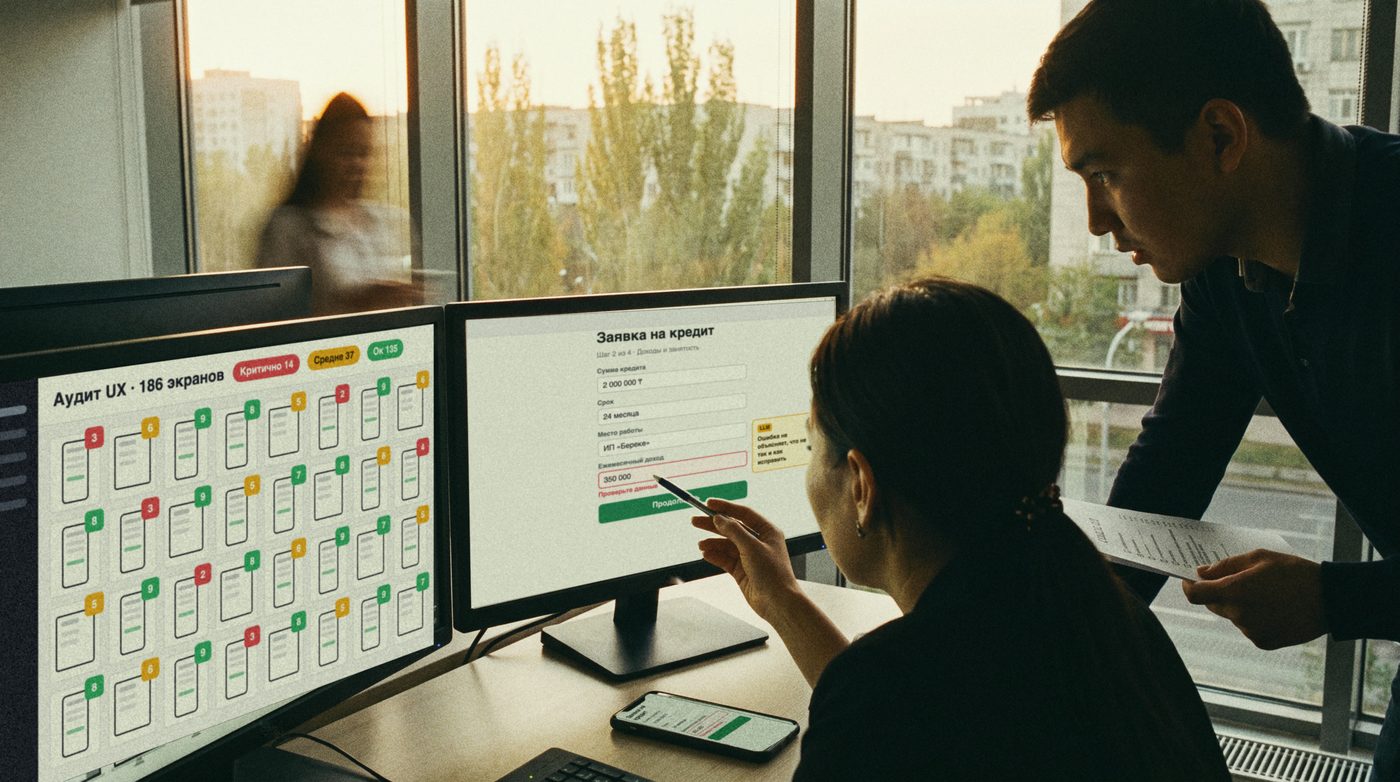


To find issues in Alatau City Bank's credit funnel, we invited 40 respondents. Analyzing 40 hours of video manually is time-consuming and expensive, so we delegated the routine work to our internal AI service, Rocket Insight Lab. Here is how automation helped uncover non-obvious product barriers.
Project details
- Client: Alatau City Bank.
- Task: Identify the reasons for user drop-off during the in-app loan application process.
- Method: Quantitative moderated usability testing.
- Scale: 40 respondents, Almaty, 2026.
- Tool: Proprietary AI service Rocket Insight Lab.
The client's initial request
The bank formulated a hypothesis: the loan application funnel in the mobile app was operating inefficiently. Dashboards recorded user drop-offs at specific stages. The client needed to validate the hypothesis and get a prioritized list of barriers.
Why a quantitative method and a real product
Classic qualitative research with 8–12 people finds interface barriers. But it does not show the scale of the problem. Without frequency data, the team does not know which error to fix first.
We organized testing with 40 respondents. With such a sample size, the frequency of a barrier becomes an argument for making business decisions.
Participants went through the scenario on their own smartphones in the release version of the app. This allowed us to account for device diversity, mobile connection quality, and lighting.
Participant screening
We selected respondents for a first-time loan application scenario. Sample requirements:
- Citizens of Kazakhstan from Almaty aged 18 to 65.
- Banking service users open to considering loans.
- No active loans with the client bank.
- Positive credit history with no past-due payments.
- Willingness to submit a real application in the app without final execution.
A clean credit history was a key methodological requirement. Bank rejections should not be attributed to a "bad borrower" status. Participants went through the bank's actual scoring. This allowed us to test the most complex part of the funnel—the decision-receiving stage, which is impossible to simulate on a test environment.
How the sessions were conducted
We conducted 40 in-person sessions at the Rocket Tech UX laboratory. The respondent held their own phone. An external camera recorded the device screen, grip, and finger movements. The moderator did not prompt steps. They kept the participant in the scenario and recorded moments when expectation diverged from reality.
Rocket Insight Lab: An AI pipeline for analytics
Analyzing 40 hours of video is the main obstacle to frequent quantitative research. Manual transcription, dialogue tagging, and frequency counting burn through budget and deadlines. We delegated these tasks to the AI service Rocket Insight Lab.

How the algorithm works:
- Transcription with timecodes. The video is converted to text. The system separates remarks by speaker and links them to seconds in the recording.
- Initial tagging. The algorithm searches for candidate fragments: questions about the interface, pauses, comments about errors.
- Pattern clustering. The AI consolidates similar observations from different sessions into unified groups. This eliminates the human factor—the algorithm does not forget phrasing from the first interviews by the end of the sample.
- Pain point formation. Patterns are assembled into descriptions of specific problems.
- Frequency counting. The service calculates in how many of the 40 sessions each problem appeared. This is the baseline for fair prioritization.
- Traceability. Every statement in the report is linked to the original timecode. We documented 97 observations, any of which can be double-checked in one click.
The researcher's role
AI took over the routine but left decision-making to humans. The UX researcher validated clusters, removed false positives, described behavioral mechanics, and formulated product recommendations.
The data processing stage was reduced from an estimated 60 hours to an actual 12 hours. Analytics costs decreased by 80%. We invested the freed-up resources into the depth of analysis—uncovering and verifying cross-connections between different barriers.
How we prioritized findings
A team cannot take on 11 barriers at once. We ranked them by two metrics:
- Frequency—how many of the 40 participants encountered the problem.
- Criticality—whether a person can solve the problem themselves, and whether they leave the funnel.
We separated these concepts. A frequent but minor problem can cause momentary irritation. A rare but critical problem can lead to a client leaving for a competitor—which is why they should be prioritized in the backlog.
Research results: aggregated data
We quantitatively confirmed the client's hypothesis. The suspected problem turned out to be the most widespread—it affected more than half of the participants. In total, we found 11 barriers across five funnel stages.
However, the highest value to the project came from barriers that were not in the bank's hypotheses. They cannot be detected through product analytics or expert audits:
- Hidden blockers. At the identification step, some respondents could not proceed. In the bank's analytics, this looked like a user error. Video recordings of the sessions revealed the real cause. The discovered blockers were handed over to the bank's specialized teams.
- Post-error scenario. If something went wrong at one of the steps, the user was returned to the beginning of the application. Such cases formed a general pattern, and they needed to be resolved at the level of the entire scenario, not individual screens.
- Trust barrier. Some people refused to provide data due to privacy concerns. Improving the interface does not work here. The product needed an alternative path.
- Communication transparency. Respondents did not understand financial terminology. Clients left to compare terms on external platforms, from which they could switch to competitors.
Product impact
The bank received a sprint-ready backlog:
- A prioritized list of 11 barriers with exact frequencies.
- 97 documented insights with video confirmations.
- Task division for teams. Some problems were handed over to interface designers, some to developers, and some went to the business requirements level.

Main insight: The most widespread problem was located at the final step of the funnel. The user had already spent maximum effort filling out the application. Eliminating the barrier at this point will give the business the highest conversion return.
Bottom line
Combining an expert approach with specialized services changes the standard of UX research. AI removed the routine workload from researchers, allowing them to focus on the product's architectural connections. The client received reliable data for conversion growth without overpaying for manual analytical labor.
"Marketing effectiveness also depends on how easy it is for a client to apply for a product. Rocket Tech's research confirmed our hypotheses about barriers during loan application and helped determine priority improvements for customer convenience and conversion growth."
 Rustam AlievCMO Alatau City Bank
We can conduct the same research for your product
Rocket Tech conducts quantitative and qualitative product research in its own AI UX laboratory in Almaty: usability testing, in-depth interviews, prototype and release product testing, diary studies, and A/B experiments.
Learn more about the types of research for your products on the Discovery page.