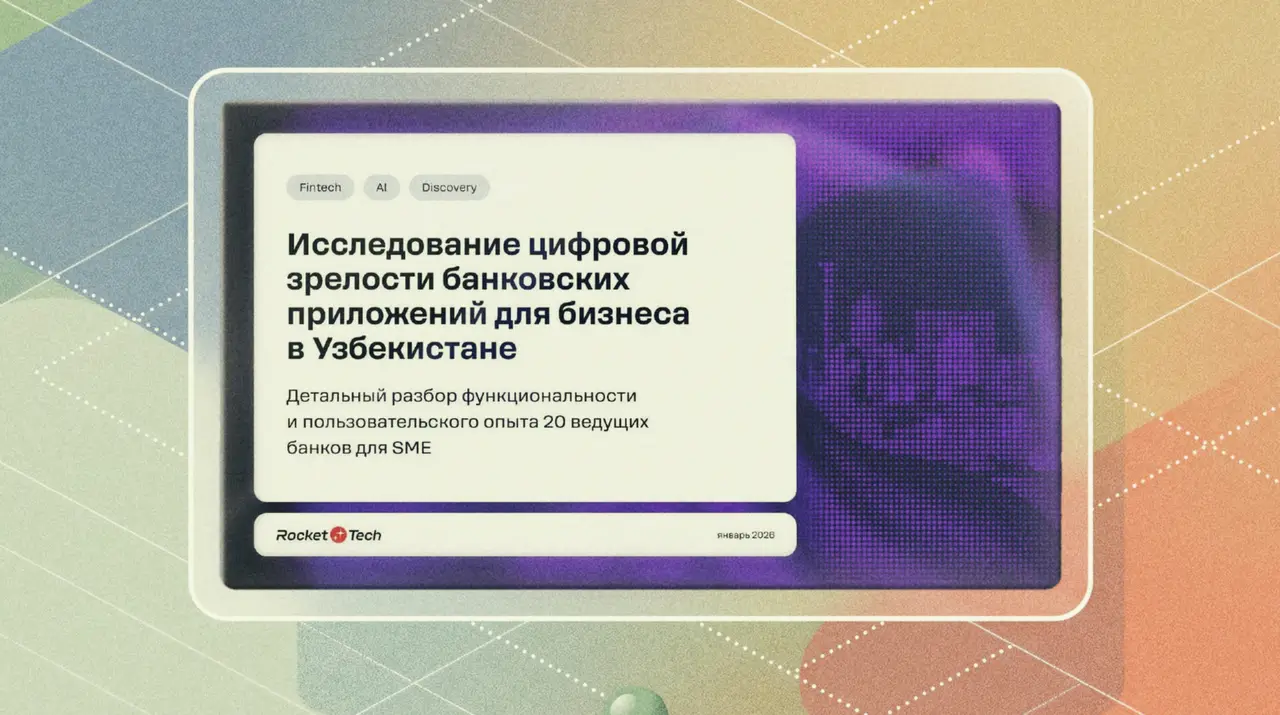
The study was conducted by Rocket Tech in January–February 2026 through in-depth interviews with people in Uzbekistan. It focuses on customer experience in Uzbekistan’s banking and payment ecosystems.
The respondents were 10 people from Uzbekistan of different genders, ages (18–24 and 25+) and levels of experience with banking ecosystems.
- 10
- in-depth interviews
- 4
- user types
- 12
- ecosystem services
- 2026
- January–February
Key findings
- Mature areas. Payments and transport are the most developed service types within ecosystems. Payme and Uzum share the lead.
- Systemic gaps. Personal finance tracking, health, children’s finance and investment suffer from a critical lack of integration with payment and banking ecosystems.
- Unmet demand. Searching for and processing information with AI is an unmet need among the tech-savvy part of the audience, with a high trust barrier.
12 parts of the study
Each part is a detailed review of one service: how different user types use it, a score from 0 to 10, respondent quotes, blockers and barriers.
Score map
How well banking ecosystems meet the needs of each user type in each service, scored from 0 to 10. On the right is the average per service, at the bottom the average per user type.
| Service | Ecosystem nomads | Cautious functionalists | Young users | Refusers / Minimalists | Average |
|---|---|---|---|---|---|
| Payments and transfers | 8 | 7 | 6 | 5 | 6,5 |
| Fashion shopping | 6 | 5 | 5 | 4 | 5,0 |
| Entertainment | 5 | 4 | 3 | 3 | 3,8 |
| Search and AI | 4 | 4 | 5 | 3 | 4,0 |
| Grocery delivery | 5 | 6 | 5 | 4 | 5,0 |
| Transport | 8 | 6 | 6 | 5 | 6,2 |
| Finance tracking and planning | 4 | 3 | 3 | 3 | 3,2 |
| Government services | 5 | 4 | 4 | 4 | 4,2 |
| Travel | 4 | 4 | 3 | 3 | 3,5 |
| Children’s finance | 2 | 2 | 1 | 2 | 1,8 |
| Health | 2 | 2 | 1 | 1 | 1,5 |
| Investment | 3 | 3 | 2 | 2 | 2,5 |
| Average | 4,7 | 4,2 | 3,7 | 3,2 |
9–10 excellent7–8 good5–6 average3–4 weak0–2 critical
Four user types
Ecosystem nomads
Multi-ecosystem, IT, 25+ · average score 4.7
Tech-savvy, work in IT. Critical of UX, make deliberate choices between apps.
“It would be great to have a neural network that knows every bank’s products — comparing would be easier” (Azamat)
AI readiness: high. Actively use ChatGPT for financial tasks. Know exactly what they want from a bank’s AI.
Cautious functionalists
Stability over features · average score 4.2
Women aged 18–25+, use 2–3 apps for specific tasks. Sceptical of new products.
“I’d be wary of AI accessing my data — it’s unclear how the information might spread” (Visola)
AI readiness: cautious. Use ChatGPT for everyday tasks. Reserved about financial advice and expect guarantees.
Young users
Digital newcomers, open to new things · average score 3.7
Young people aged 18–25+ entering the ecosystem. Their choice of bank is often random.
“I don’t see any downside to a bank’s AI having access to my data” (Sardor)
AI readiness: open. The lowest trust barrier. Use Gemini and ChatGPT. Ready for a bank’s AI.
Refusers / Minimalists
Negative experience, bare minimum · average score 3.2
Tried Click, Humans and TBC, then dropped them over technical issues and hidden charges.
“As for AI in financial systems, I wouldn’t give it full access — I don’t trust it yet” (Abduvakhid)
AI readiness: critical. AI in a bank is not seen as normal. Maximum caution after negative experience.
The same study in the neighbouring country: Banking Ecosystems of Kazakhstan 2026.