A bank in Kazakhstan was developing its mobile app at speed. Teams shipped one new feature after another, and the user base kept growing. At that pace it is hard to see the product as a whole: how it compares with competitors, where customers stumble, and whether development can handle the next stage of growth.
The bank commissioned an independent audit of its mobile banking. The work was led by a 14-person Rocket Tech team of designers, an editor, an analyst, mobile, backend and frontend developers, and QA and DevOps engineers.
Challenge
Get a complete picture of the product and a prioritised list of solutions. To do that, the audit had to answer three questions:
- how the app compares with the market and what users think of it;
- how easily customers get things done in the app, from sign-up to a loan;
- whether the code, infrastructure and development processes are ready for the product to grow.
How the audit works
The report has five sections: competitive analysis, user feedback, customer journeys, UX/UI and technical audit. Five methods were used:
- Survey and interviews. A questionnaire with a standard set of questions on the strengths and weaknesses of banking apps, plus in-depth interviews with some of the respondents.
- Manual testing. Journeys, interface solutions and behaviour in edge cases were checked by hand in the bank’s app and in competitors’ apps.
- Checklist review. A list of core and additional banking app features.
- Market research. Data from mobile banking studies in other markets.
- Expert assessment. Recommendations from a team that builds mobile apps for banks itself.
The market and customer views
The bank’s app was benchmarked against nine apps of Kazakh banks on 16 criteria, including speed, navigation, quality of language versions, QR payments, support chat, government services, spending analytics and non-banking products. Each criterion was scored, an average score was calculated for each app, and a short conclusion was drawn.
More than 50 people took part in the surveys and interviews. Their answers confirmed that the mobile app has become the bank’s main channel. 88.9% of respondents use mobile banking every day or almost every day, and 71.1% hardly ever open the web version. Feedback on the app itself was sorted into pros and cons and backed by user quotes.
Customer journeys
How a product feels depends on how easily it meets a specific need. So the user experience was assessed through six key journeys:
- Sign-up. Open a card or an account.
- Deposit. Save and grow money.
- Loan. Get money quickly.
- Payment. Pay utility bills, top up a balance.
- Transfer. Help family, pay for services.
- Rewards. Get cashback for loyalty.
Each journey is mapped “as is”. Notes on the steps show where customers take an unnecessary action and where they don’t understand what happens next. Alongside are conclusions and a revised “to be” map.
Interface and copy
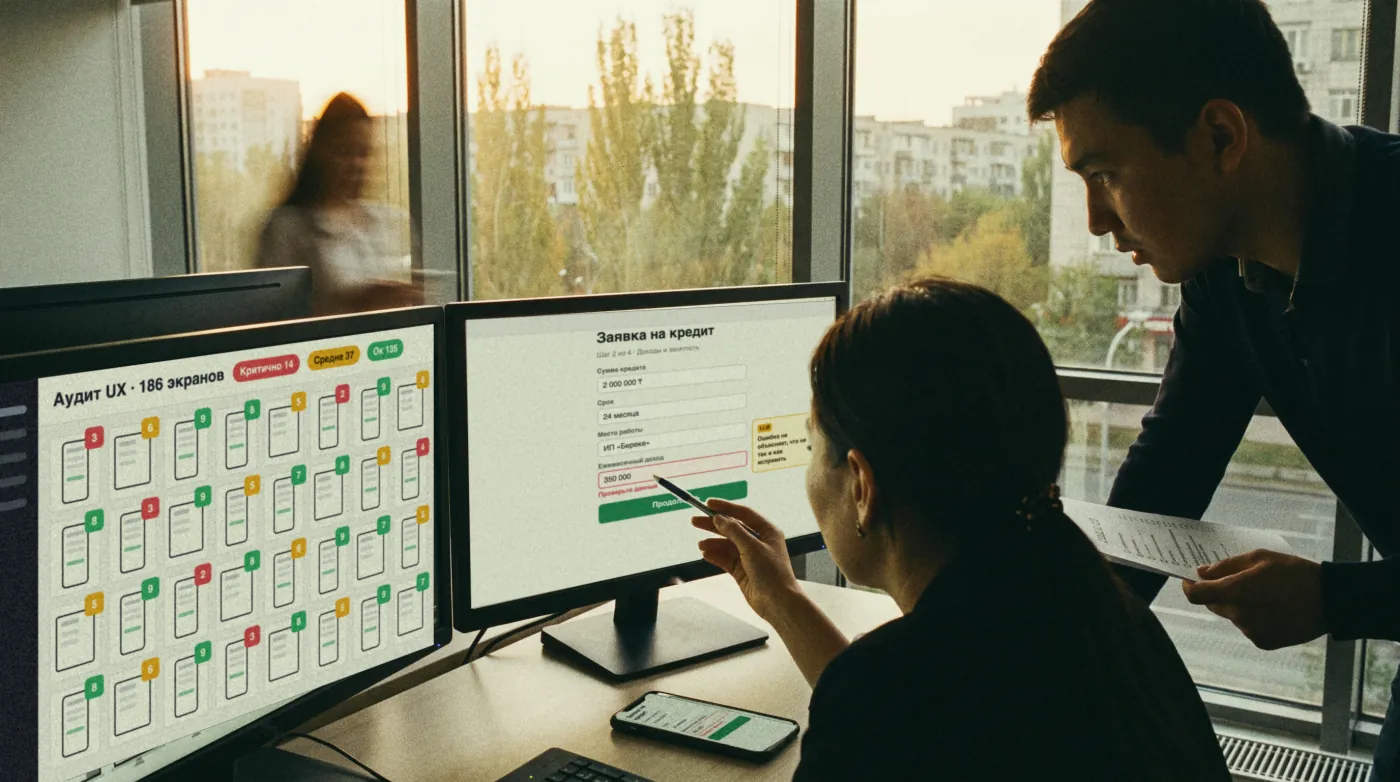
The UX/UI audit draws on expert assessment, the checklist and user interviews. Findings fall into three groups:
- Navigation and consistency of elements. Places where elements with the same meaning look and behave differently.
- Copy. Buttons, labels and messages follow different rules. An editorial policy is recommended to bring all customer communication into a single format.
- Technical glitches on screens. Both minor layout issues and errors that prevent completing a transaction were analysed. For each one, the report shows how it affects trust in the app.
Technical review
The technical audit takes a product-driven approach to development into account. It draws on a staff survey, a review of the source code and architectural decisions, and an analysis of networks, cloud and tooling. We also checked separately how automated security and code quality checks are built into the development process.
Seven areas were reviewed: architecture, DevOps, analytics, mobile development, backend, frontend and QA. Findings are grouped by topic, including code quality and review, documentation, testing, infrastructure, product analytics and internal processes. Each area has its own recommendations.
Result
The bank received a report of more than 120 slides. It is a shared basis for decisions by the product, design and development teams:
- Market position. An assessment of the app against nine competitors on 16 criteria, plus the voice of users.
- Journeys. Six key journeys with “as is” and “to be” maps.
- Interface. A list of fixes. Many are inexpensive yet noticeably raise interface quality.
- Development. Recommendations across seven areas make processes more systematic, so that the speed of shipping new features does not come at the expense of stability. They include automated code security checks and security testing in every release.
Recommendations are prioritised. It is clear which changes will quickly benefit customers and which are needed for the product to grow without failures.