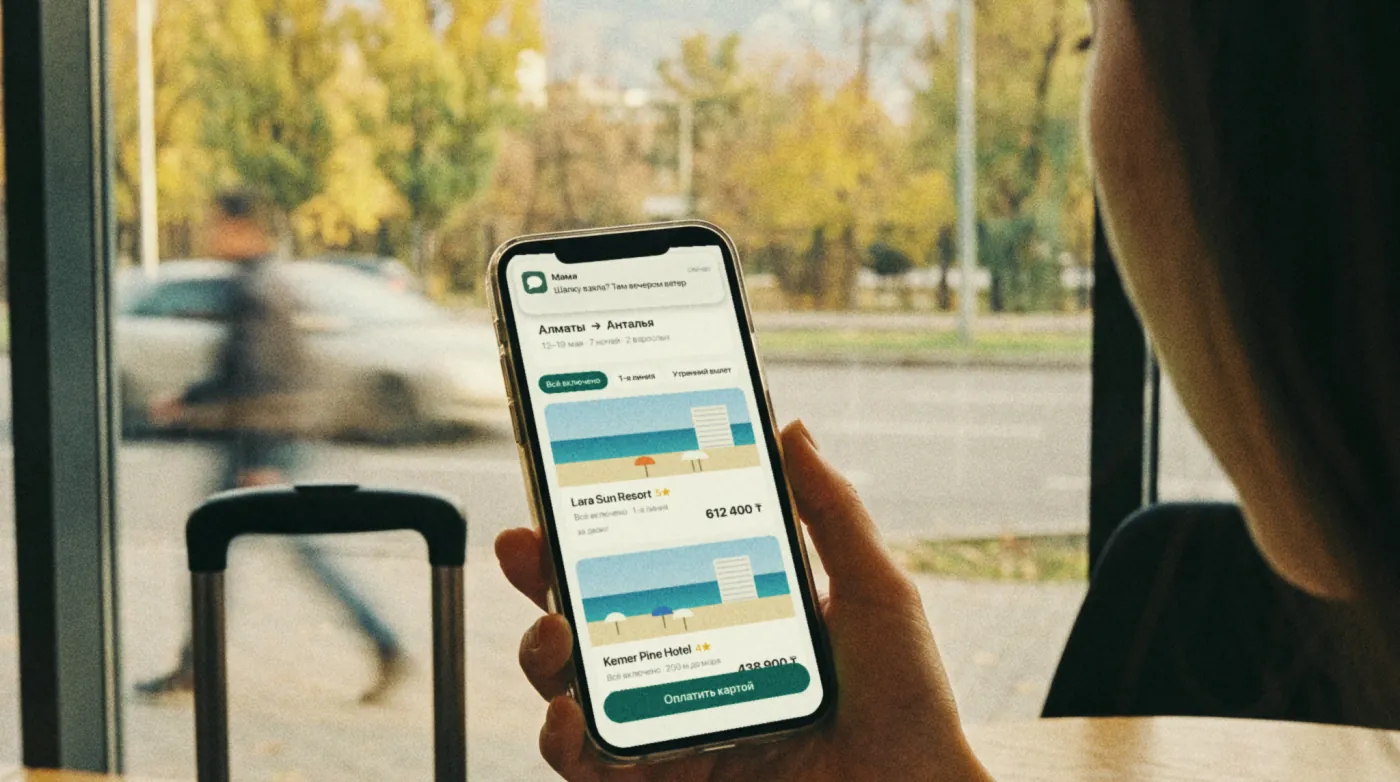
Five steps without leaving the app
Destination and dates → filters → hotel and tour → payment → documents. Customer details and card are filled in from the bank profile.
Partner tours in the bank’s app: search, card payment and documents. The first version takes about 3 months, followed by bank reviews and a closed pilot.
Travel in super apps: a checkout, but no service
Kazakhstan. Kazakhstanis spend ₸5 trillion a year abroad by card, and super apps already sell tickets at a commission of about 5% of turnover, but banking apps account for less than a tenth of organized tours — an unoccupied niche with a ready audience. Uzbekistan. The fastest-growing outbound market in the region: 7.6M trips a year, and in-app ticket and tour sales are still up for grabs.
Tour search, payment and documents — in the bank’s app.
The bank’s app integrates with the tour provider’s API through a proxy layer with no database of its own. Architecture approvals, security and antifraud are built into the implementation plan.
Destination and dates → filters → hotel and tour → payment → documents. Customer details and card are filled in from the bank profile.
Before public launch: architecture committee, information security audit, antifraud review and a closed pilot covering purchase, payment and refund.
The first version covers tour purchase. In the first project it was ready in 2.5 months instead of the planned three. The second version — loans, installments, passport scanning — was developed during approvals.
Destination, dates, number of travelers; filters by hotel, meals and price; provider offers.
Autofill from the profile and payment through the bank’s payment infrastructure.
The voucher, tickets and insurance can be viewed and downloaded in the app.
In the second version, loans and instalments on the payment screen under the bank’s rules. Loan origination pipeline
In the second version, camera-based passport recognition to reduce manual entry.
Relays requests between the app, the bank’s systems and the supplier without storing data in its own database.
The supplier’s purchase flow is adapted to the bank’s design system components.
First line: the bank’s hotline, following the supplier’s guidelines; complex issues are resolved with the supplier’s managers.
In the second version: hotel map, ratings, reviews and caching of selections.
Choosing the supplier, the flows for both versions and the bank’s architecture, security and antifraud requirements.
Search, payment and documents; integration with the supplier and the bank, interface in the bank’s design system.
Architecture, information security and antifraud; a pilot for a limited group covering purchase, payment and refund.
After the reviews, a public launch. Second version development: loans, instalments, passport scanning, hotel map and reviews.
The second version is developed while the first goes through approvals. The bank, the supplier and the development team work to a shared plan.
A proxy layer in the bank’s infrastructure with no database of its own; the code and documentation belong to the bank. Price and timeline are set in the contract.
New features, destinations and suppliers, SLA-based support — by subscription or by the bank’s own team.
Building the team and processes for the travel line, launching it and handing it over to the bank once the agreed targets are met. How it works
“A partner service in a banking app is not a button linking to someone else’s website. The customer completes the entire journey and pays with their own card, and the bank’s reviews are built into the plan from the start, so the launch is not held up by them at the last moment.”
 Oleg KachalinCo-founder, CEO in Uzbekistan Blog “Usataya Baza”LinkedIn




No. The service is embedded as a section in the existing app and uses the bank customer’s login, card and profile.
From a supplier chosen by the bank, with an API for search, booking and documents.
The proxy layer runs within the bank’s perimeter with no database of its own. Which data is passed to the supplier for booking and support is defined by the integration scheme.
Architecture, information security and antifraud are part of the plan. Materials are prepared in advance, and issues are resolved before the public launch.
The bank’s hotline, following the supplier’s guidelines; complex questions go to the supplier’s managers. The data transfer procedure needs to be agreed during implementation.
About 3 months for the first version, followed by the bank’s reviews and a closed pilot. Loans, instalments and passport scanning come in the second version.
Your request goes to our business development team: we will get in touch, work out what needs to go live at your bank and propose a solution.
Thank you, your request has been sent
A business development manager will contact you using the details you provided.